
Performance review season turns managers into writers on a deadline, and the first draft is the hard part: the facts are in your head, the wording will not come, and the form wants specific examples in balanced language by Friday. That is the part a chat model is genuinely good at. It is not good at knowing what your report actually did this year, and it will invent achievements with total confidence if you let it. The nine prompts below are built so it cannot: every fact comes from a notes block you paste in, and anything missing comes back marked instead of made up.
What a model helps with here, and what it does not
Used carefully, a model turns rough notes into structured, even-toned review language, rephrases a harsh sentence into a fair one, and checks a finished draft for vague praise that says nothing. It cannot supply the examples, judge the work, or carry the responsibility: a review is a document about a person's pay and future, and the manager who signs it owns every sentence. The prompts keep that line by treating your notes as the only source and the draft as raw material for your edit.
The anatomy of a review prompt
Each prompt below has the same five parts our cover letter prompts use: a role line, the task, a context block holding your real notes, requirements that constrain the writing, and a format. Two requirements do the heavy lifting in reviews. The first is the honesty rule: use only the notes, and write [NEEDS EXAMPLE] where a claim has no support. The second is the balance rule: every strength names a behaviour and a result, every growth point names the gap and the support on offer. Generic reviews are what happen when neither rule is present.
For managers: positive feedback
Prompt 1, the strengths section.
Act as an experienced manager drafting the strengths section of a performance review.

Task: Write the strengths section for [NAME], a [ROLE] on my team, for the [PERIOD] review.

Context, my notes on this period: [PASTE YOUR NOTES: projects, results, behaviours you observed, feedback from others].

Requirements:
- Use only facts from my notes. Where a strength has no supporting example in the notes, write [NEEDS EXAMPLE] instead of inventing one.
- Cover at most three strengths. For each, name the behaviour, the example, and the effect it had.
- No empty praise: avoid "great team player" and "exceeded expectations" unless the notes show what was expected and what happened.
- Write about [200] words in plain paragraphs, in a tone a fair manager would sign.
Prompt 2, the recognition summary. For the short summary box most forms put at the top: same notes block, one paragraph of about 80 words, the single most valuable contribution first, no adjectives without an example attached.
For managers: constructive feedback
Prompt 3, the growth area.
Act as an experienced manager drafting a constructive section of a performance review.

Task: Write the development section for [NAME], a [ROLE], covering one growth area: [THE GAP, in one sentence].

Context: [PASTE EXAMPLES: what happened, when, what it affected]. Support I can offer: [MENTORING, TRAINING, CHANGED WORKLOAD, OR OTHER]. Timeframe we agreed: [TIMEFRAME].

Requirements:
- Describe the behaviour and its effect, never the person's character. "Two reports arrived after the deadline" is fair; "careless" is not.
- Use only my examples. If the pattern is thinner than my summary suggests, say so in [BRACKETS] so I can check myself.
- End with the support and the timeframe as a concrete next step, written as something we do together.
- About [180] words, calm and direct, no softening filler that hides the point.
Prompt 4, the fairness check. Paste a finished draft and ask the model to flag every sentence that states a judgement without an example, every comparison to unnamed colleagues, and any wording you would not say to the person's face. It returns a list, not a rewrite, so the fixes stay yours.
For managers: goals
Prompt 5, next period's goals. Give it this period's notes and the team's priorities, and require three goals, each with what done looks like, how it will be visible, and a mid-period checkpoint. Ban the words "improve" and "more" unless a measure follows them.
For self-evaluations
Prompt 6, the self-review from a work log.
Act as a writing coach helping me draft my self-evaluation.

Task: Draft my self-evaluation for [PERIOD] in my role as [ROLE].

Context, my work log: [PASTE YOUR LIST: projects shipped, problems solved, things learned, help given to others].

Requirements:
- Build the draft only from my log. Where a claim needs a number I have not given, write [ADD NUMBER] rather than estimating one.
- Structure: three accomplishments with their effect, one honest weakness with what I am doing about it, two goals for next period.
- First person, plain and specific. No boasting words like "spearheaded" unless the log shows I led it.
- About [250] words.
Prompt 7, the modest draft fix. For a draft that undersells: paste it with your log and ask for the claims your log supports more strongly than you stated, quoted back with the log line behind each. Add nothing the log does not contain.
For peer reviews
Prompt 8, the peer feedback draft. Same pattern, colleague edition: your observations of working with them, two collaboration strengths with moments attached, one suggestion framed as what would help you work together better. Peer reviews rot fastest into generic praise, so the [NEEDS EXAMPLE] rule matters most here.
Prompt 9, the tone pass. Paste any review draft, yours or one you are calibrating, and ask for the sentences that could read as personal rather than professional, with a neutral rewording of each. You decide which rewordings to take.
What never goes into a review prompt
Salary figures, anything medical, disciplinary history, and other people's reviews or names beyond the person being reviewed. Notes about the reviewee's own work are the job; the rest is confidential material in a consumer tool, and none of these prompts need it. Names themselves are worth a second thought: initials work fine in the slots, and you can restore real names in the final document.
Where PromptPolish fits
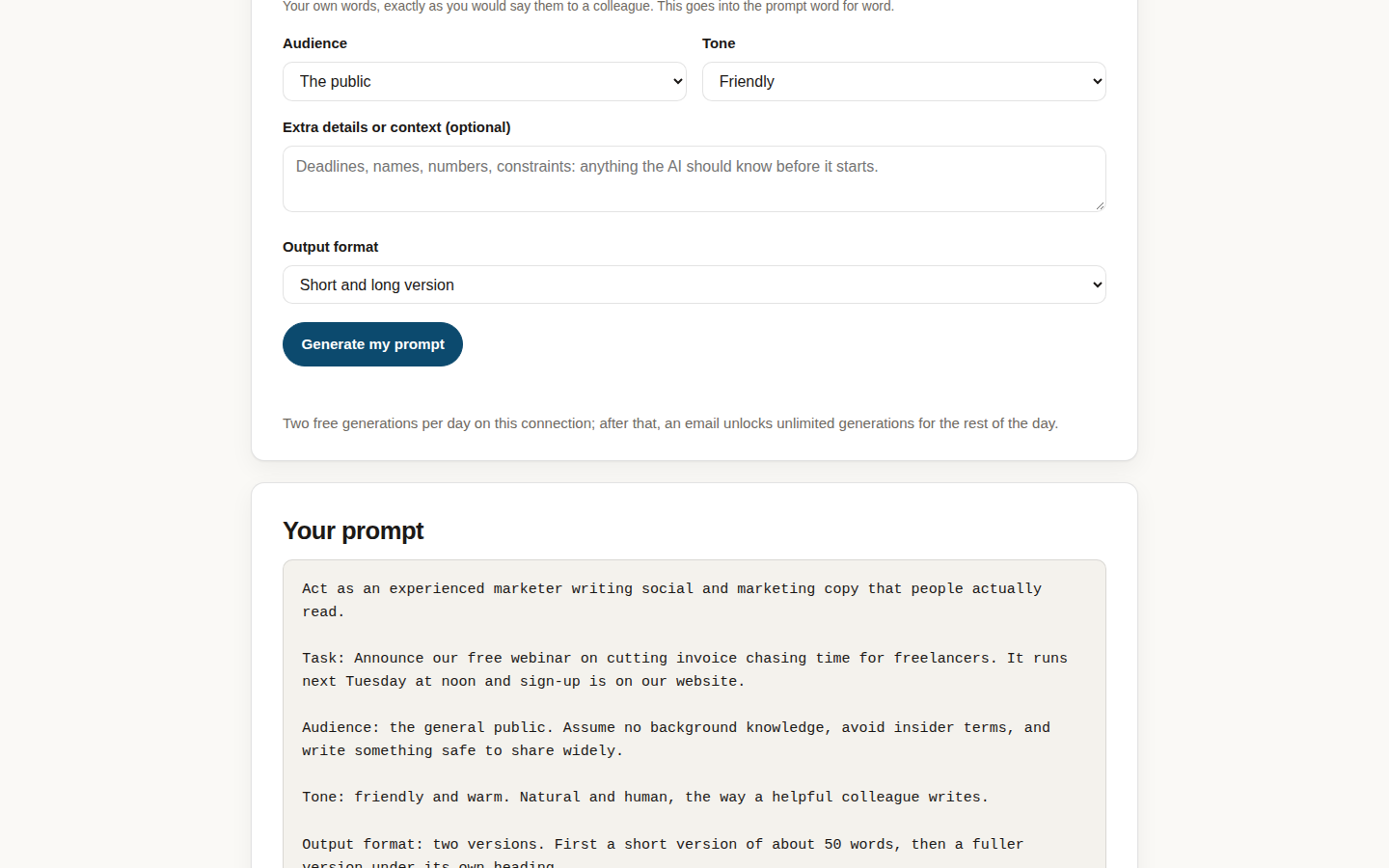
PromptPolish, this site's free builder, has no performance review family; its ten families run from email and reports to meetings and hiring. The overlap is the structure: pick the team lead role with the report family and it assembles the same skeleton these prompts are built on, role line, your task, audience, tone, format, plus that family's built-in requirements, which for reports include flagging estimates as estimates. That makes it a fast way to spin a variant of Prompt 5 or Prompt 6 for a different report or a different period without rebuilding the frame. The explainer walks through the controls; two generations a day are free, then an email unlocks the rest of the day.
Reviews written this way still need the slowest step done by hand: reading every sentence and asking whether you could defend it, kindly, to the person it describes. The prompts get you a fair first draft fast. Fair is the part you sign for.