
Most freelancer prompt lists hand you one generic "write me a proposal" template and forty prompts for everything after. The proposal itself is where the money is decided, and it is not one document: the proposal for a fresh lead, the one against three competitors, the one where the budget is half your rate and the follow-up when a good one goes quiet are four different writing jobs. Below are seven prompts, one per job, all built on the same anatomy, plus the facts block every one of them needs before it can write a word worth sending.
What most proposal prompts get wrong
They ask for persuasion before facts. A model told to "write a winning proposal for a website project" invents your experience, your timeline and occasionally your prices, and the result reads like every other AI proposal the client received that week, because it is one. A proposal is a matching document, like the cover letter: the client's stated problem against your specific evidence. So every prompt below starts with a facts block, and the first requirement is always the same: use only the block, and mark what is missing.
The facts block, filled once and reused
My facts: I am a [YOUR SKILL] with [N] years of experience. Relevant past work: [PROJECT 1: client type, what I delivered, one result]. [PROJECT 2]. My rate for this kind of work: [RATE OR RANGE]. My availability: [START DATE, HOURS PER WEEK]. My process: [HOW YOU WORK, IN TWO LINES]. Proof a client can check: [PORTFOLIO LINK, TESTIMONIAL, OR PROFILE].
Keep that block in a note and paste it under every prompt below. Filling it once is the whole discipline; it is also what makes the outputs sound like you instead of like a template.
Prompt 1: the new project proposal
Act as an experienced freelancer writing a proposal in my voice.

Task: Write a proposal for this project: [PASTE THE CLIENT'S BRIEF OR JOB POST].

My facts: [PASTE YOUR FACTS BLOCK].

Requirements:
- Open with the client's problem in their words, not with my biography.
- Then: how I would approach it, in three steps; the evidence from my facts that I can do it; what I need from the client to start.
- Price and timeline appear only if my facts state them; otherwise write [PRICE] and [TIMELINE] as slots for me.
- No invented clients, results or testimonials. If the brief asks for something my facts do not cover, flag it as [GAP] at the end.
- About [300] words, plain paragraphs, ending with one clear next step.
Prompt 2: the competitive pitch
When the client is comparing freelancers, add the brief and one line about what the cheaper or bigger options cannot offer, speed, seniority, a niche, and require the draft to name that difference once, early, with evidence from the facts block, and never to mention competitors by name or to disparage them. Difference stated with proof beats adjectives about quality every time.
Prompt 3: when the budget is below your rate
Act as an experienced freelancer answering a client whose budget is below my rate, without apologizing for the rate or discounting it silently.

Task: Write my reply to this brief: [PASTE BRIEF, INCLUDING THEIR BUDGET]. My facts: [PASTE FACTS BLOCK]. Their budget is [BUDGET]; my rate for the full scope is [RATE].

Requirements:
- Thank them, then split the scope into what their budget covers well and what it leaves out, priced honestly from my facts.
- Offer the smaller scope as a complete, useful deliverable, not a diminished version.
- Name what adding the rest later would involve, without inventing figures beyond my rate.
- End with the choice in their hands and one question that moves it forward. About [200] words, warm and unbothered.
Prompt 4: the retainer proposal
Retainers fail on vagueness, so this prompt requires a monthly shape: a fixed number of hours or deliverables from your facts, a response time you can keep, what rolls over and what does not, and a review point at month three. If your facts block does not state a term, the prompt leaves [TERM] as a slot rather than promising one for you.
Prompt 5: the scope expansion
For the existing client mid-project: the prompt quotes the original scope from the brief you paste, describes the new request in one paragraph, and prices the addition as a separate line with its own timeline effect, so the client approves an addition instead of absorbing a surprise. Require it to state plainly whether the original deadline moves.
Prompt 6: the executive summary
Long proposals get skimmed from the top, so draft the summary last and separately: five lines maximum, the client's problem, your approach, your one best piece of evidence, the price slot, the start date. A summary written from the finished proposal, rather than before it, matches what the document actually says.
Prompt 7: the follow-up after silence
Act as an experienced freelancer following up on a proposal that has had no reply.

Task: Write a short follow-up email. I sent the proposal on [DATE] for [PROJECT, ONE LINE]. The client's situation since: [ANYTHING NEW, OR "nothing known"].

Requirements:
- One idea only: make replying effortless. Restate the decision they need to make in one sentence.
- Add one genuinely useful thing if my notes provide it, a relevant link, a deadline of theirs I can help with; invent nothing.
- No guilt, no "just bumping this", no fake urgency. Under [100] words, with a subject line.
Frequently asked questions
Can AI write a client-ready proposal on its own? It can draft one from your facts. Client-ready still means you read it, fill the price and timeline slots, and remove anything you would not say on a call. The prompts are built to leave those decisions visible instead of papering over them.
Should a proposal prompt include my prices? Only real ones, inside the facts block. A model that invents a plausible price has created a quote you never made, and clients keep screenshots.
How long should a freelance proposal be? Long enough to cover problem, approach, evidence and terms, which for most project briefs is 250 to 400 words. The prompts carry the number as a slot because a two-day audit and a three-month build do not deserve the same length.
What if the brief asks for work outside my facts? That is what the [GAP] flag is for. Seeing the gap in the draft lets you decide to subcontract it, learn it, or decline it, instead of discovering at delivery time that your proposal promised it.
Where PromptPolish fits
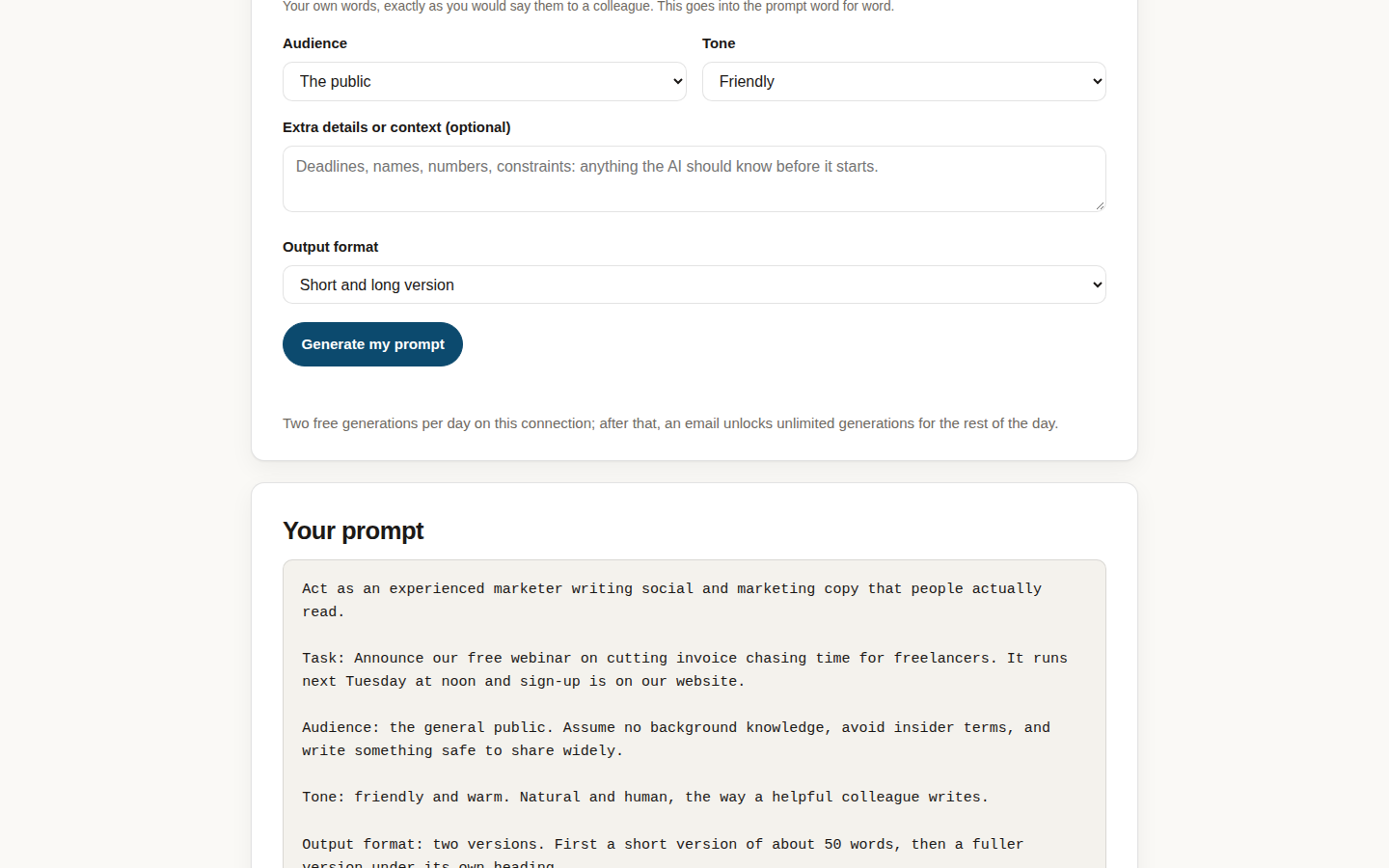
PromptPolish, this site's free builder, has no proposal family either; as our cover letter guide puts it, pick the freelancer role with the email or plan family and you get the same skeleton these prompts are built on, role line, your facts as the task, audience set to client, tone and format chosen, plus that family's built-in requirements. It is the quickest way to rework Prompt 7 for a different client or a firmer tone without retyping the frame. Two generations a day are free, then an email unlocks the rest of the day; the explainer walks through it. And once a proposal lands, our freelancers guide covers the tools for the contracts, invoices and client messages that follow.
A proposal is a promise with a price attached. Prompts that work only from your facts keep the promise one you can keep.